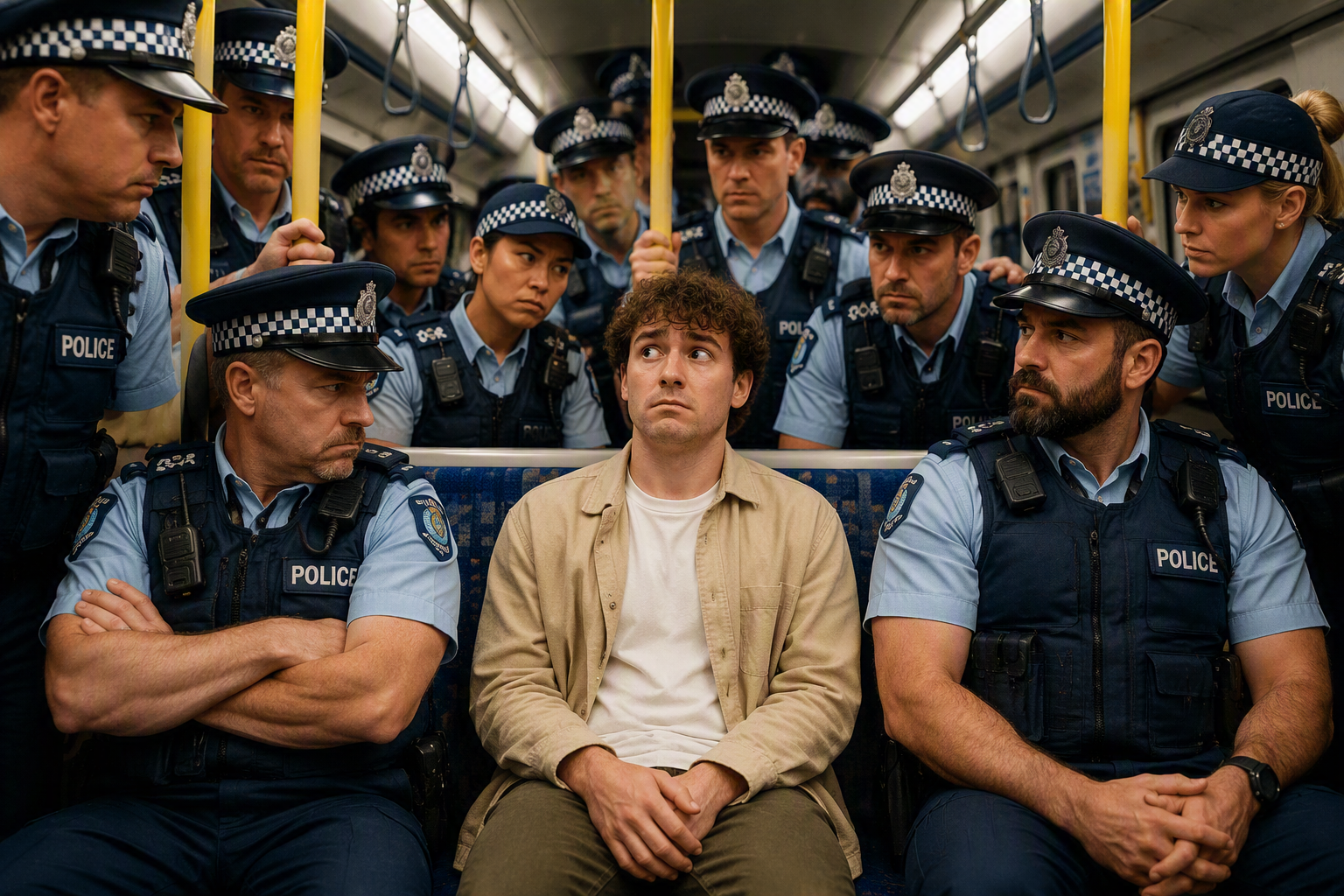
Officials say the move is a natural next step after determining that visible police presence works best when it exceeds the number of visible members of the public.
AUCKLAND — Following the announcement of a dedicated Auckland Transport Police Team to improve safety on buses, trains and ferries, government officials have unveiled a long-term strategy to ensure every public transport passenger is eventually accompanied by their own fully sworn police officer.
The proposal follows concerns that the opening of the City Rail Link will significantly increase passenger numbers and create opportunities for anti-social behaviour.
“Public transport is changing,” said Acting Deputy Associate Commissioner for Transport Visibility Outcomes, Neville Clipboard. “Historically, one police officer may have been expected to oversee hundreds of commuters. Current thinking suggests that ratio could be improved.”
Under the initial phase, 50 additional officers would patrol Auckland’s public transport network. However, an accompanying 412-page Cabinet discussion document, Toward a Safer Future Through Increasingly Concerning Numbers of Police, outlines a pathway to achieving a one-to-one commuter-to-officer ratio by 2032.
A second phase would assign two officers to each passenger “for redundancy purposes”.
Transport officials welcomed the proposal, noting that many Aucklanders currently spend long periods waiting for buses that never arrive and are therefore ideal candidates for proactive policing.
“If someone waits 47 minutes for a bus and then discovers it was cancelled three hours earlier, that’s an emotionally complex public-safety environment,” explained Clipboard.
The initiative has already undergone successful trials.
At a pilot operation in Newmarket, six commuters were accompanied by 34 officers, three operational planners, two behavioural analysts, a transport reassurance consultant and a Labrador named Compliance.
Officials reported a 100 percent reduction in crimes committed by those six commuters during the assessment period.
Critics noted that none of the commuters had previously committed any crimes.
Officials described this as “an encouraging early result”.
To support the expansion, Auckland Transport will begin redesigning stations. Instead of ticket barriers, passengers will pass through a series of reassurance checkpoints where officers verify they continue to feel safe.
Those unable to demonstrate sufficient levels of reassurance may be referred to the newly established National Confidence Processing Centre in Hamilton.
A recent survey by the Institute for Measurement of Government Success found 83 percent of Aucklanders support safer public transport, while 79 percent oppose anti-social behaviour, and 94 percent agreed that statistics become more convincing when presented in a colourful infographic featuring arrows.
The transport policing strategy has also triggered an unexpected recruitment challenge.
Despite plans to hire additional officers, the Government estimates Auckland’s commuter population could eventually exceed the available supply of police.
To address this, officials have proposed recruiting volunteer “Community Deputy Commuter Constable Associates”, whose primary role will be accompanying police officers accompanying commuters.
A training manual circulated last week advises recruits to maintain eye contact with the officer they are supporting and to report any suspicious passengers attempting to travel without adequate supervision.
Some public transport advocates remain cautiously optimistic.
“I just wanted a train that arrived on time,” said Mt Albert resident Sarah Whetstone while standing beside four officers assigned to monitor her morning coffee purchase.
“Now I apparently have a Tactical Rail Support Team. They’re lovely, but they’ve started conducting threat assessments on my muffin.”
Meanwhile, political parties have begun competing on transport safety policy.
One proposal would station officers every three metres along rail corridors.
Another would replace all train conductors with detectives.
A third would classify arriving at Britomart before 9am as probable cause.
The idea has historical precedent. Government researchers point to the largely forgotten Wellington Escalator Safety Initiative of 1998, in which escalating concerns about escalator incidents led to each escalator receiving its own oversight committee, legal adviser, safety auditor and commemorative plaque.
The programme was eventually discontinued after officials discovered nobody could physically access the escalators.
The latest complication emerged this week when modelling showed the growing transport police presence may itself require a separate transport system.
Auckland Transport has therefore begun consulting on a dedicated Police Rail Link, or PRL, allowing officers to travel efficiently between commuters.
Early forecasts suggest passenger demand on the PRL could become so high that every officer may eventually require their own officer.
Officials insist that outcome remains several years away… For now.